The Shifting Geography of APAC Headquarters
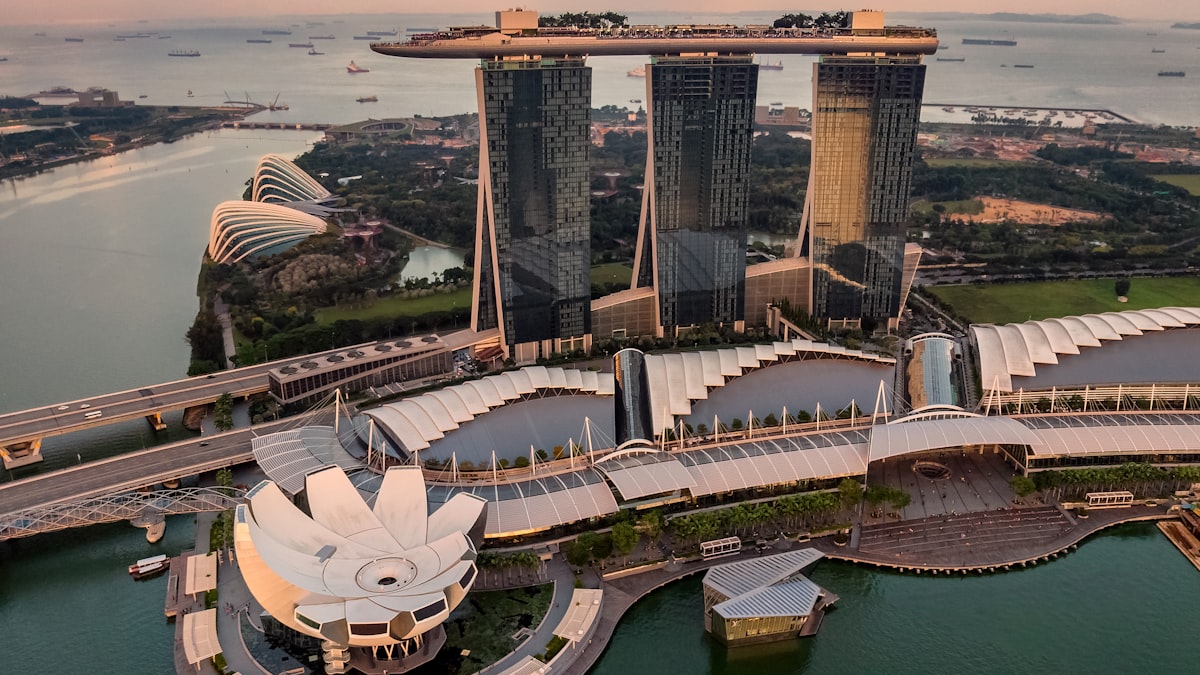
For decades, the question of where to place an Asia-Pacific regional headquarters had a default answer: Singapore. The city-state's political stability, rule of law, efficient bureaucracy, and 17% corporate tax rate made it the unquestioned choice. As of 2025, over 4,200 multinational companies maintain regional headquarters in Singapore, according to the Economic Development Board (EDB).
But the calculus is shifting. India overtook Japan in 2025 to become the world's fourth-largest economy. GDP growth of 6.6% for FY 2026-27 (IMF projection) makes it the fastest-growing major economy for the third consecutive year. India accounted for nearly 68% of total office leasing and 55% of new supply across the top 11 APAC markets in 2025, according to Colliers. The country recorded the strongest growth in office investments across Asia-Pacific.
The question is no longer "India or Singapore?" — it's "How do I use both strategically?" Companies like TDK Corporation announced in March 2026 a dual-city APAC RHQ structure: Bengaluru anchoring the growth agenda with India's deep engineering talent, and Singapore anchoring governance, compliance, and supply chain operations. This article provides the framework for making that decision.
Singapore: The Governance and Compliance Hub
Why Singapore Remains Indispensable
Singapore's strengths as a headquarters location are structural and difficult to replicate:
- Regulatory clarity: The Companies Act is straightforward, ACRA filings are digital, and corporate governance standards are globally respected. Audited financials, AGMs, and director duties follow international best practices.
- Tax efficiency: The headline corporate tax rate is 17%, with an effective rate often lower due to incentives. The Regional Headquarters Award (RHA) provides a concessionary rate of 15% on qualifying income for 5 years. The International Headquarters Award (IHA) offers rates as low as 5-15% for companies exceeding RHA requirements.
- Treaty network: Singapore has 90+ double taxation avoidance agreements, making it ideal for holding structures. The India-Singapore DTAA provides favourable withholding tax rates: 15% on dividends, 10% on interest (bank loans), and 10% on royalties and technical fees.
- Neutrality: As a hub serving operations across China, Japan, Korea, India, and Southeast Asia, Singapore offers perceived neutrality that no single large-market country can match.
- Banking infrastructure: All major global banks maintain full-service operations. Multi-currency treasury management, trade finance, and cross-border payment systems (including UPI-PayNow linkage with India) are seamless.
Singapore's RHA and IHA Incentives — What They Require
To qualify for the Regional Headquarters Award, companies must meet these minimum requirements:
| Requirement | By Year 1 | By Year 3 |
|---|---|---|
| Paid-up capital | SGD 200,000 | SGD 500,000 |
| Annual business spending | SGD 2 million | SGD 3 million |
| Professional headcount | 10 employees | 15 employees |
| Countries managed | 3 countries | 3 countries |
The International Headquarters Award requires substantially exceeding these thresholds, with concessionary rates negotiated case-by-case with EDB. Companies managing 5+ countries with significant regional revenue typically qualify.
India: The Growth and Talent Engine
Why India Is Winning the Talent Argument
India's case for hosting APAC headquarters functions is not about replacing Singapore — it's about accessing capabilities that Singapore simply cannot match at scale:
- Engineering talent: India produces over 1.5 million engineering graduates annually. Bengaluru alone has more tech talent than most APAC countries combined. The deep pool spans software development, data science, AI/ML, and increasingly, chip design following the PLI scheme semiconductor push.
- Cost arbitrage: A senior finance professional in Singapore costs SGD 180,000-250,000 annually. An equally qualified professional in India costs INR 25-40 lakh (SGD 40,000-65,000). For a 50-person regional team, the annual savings exceed SGD 5 million.
- Market proximity: India's consumer market of 1.4 billion people is the largest growth opportunity in APAC. Having decision-makers on the ground — understanding GST complexity, FEMA regulations, and local market dynamics — produces better outcomes than managing from 3,800 km away.
- Infrastructure acceleration: PM Gati Shakti has connected India's logistics network. The National Infrastructure Pipeline exceeds USD 1.4 trillion in planned investment. Office grade infrastructure in Bengaluru, Hyderabad, Pune, and Gurugram matches global standards.
India's Tax Proposition for Headquarters
India's tax framework for foreign-invested companies has improved significantly:
| Entity Type | Base Tax Rate | Effective Rate (with surcharge + cess) |
|---|---|---|
| Domestic company opting into the concessional regime (section 200 read with section 205(1)) | 22% | 25.17% |
| New manufacturing company that commenced production on or before 31 March 2024 (section 201 read with section 205(2)) | 15% | 17.16% |
| Foreign company (branch/PE) | 35% | 38.22-37.13% |
| Company not opting for new regime | 30% | 34.94% |
The key insight: a wholly-owned subsidiary incorporated in India pays an effective rate of 25.17% under section 200 read with section 205(1) of the Income-tax Act, 2025 (section 115BAA of the Income-tax Act, 1961) — significantly lower than the 38-42% rate for a branch office or permanent establishment. The deeper 17.16% manufacturing rate under section 201 read with section 205(2) (section 115BAB of the Income-tax Act, 1961) is available only to companies that commenced manufacturing on or before 31 March 2024, so a new plant today budgets on 25.17%.
GIFT City IFSC — India's Answer to Singapore
Gujarat's GIFT City International Financial Services Centre (IFSC) is India's strategic attempt to compete with Singapore for financial services headquarters. Key advantages include:
- Tax holidays: 100% income tax exemption for 10 out of 15 years for units in IFSC
- GST exemption: Services provided in IFSC are exempt from GST
- Single regulator: IFSCA provides a unified regulatory framework, unlike India's multi-regulator domestic environment
- Lower operating costs: 40-50% cheaper than Singapore for comparable financial services operations
However, GIFT City's ecosystem remains nascent compared to Singapore's deep capital markets, established legal frameworks, and global banking presence. It works best for treasury centres, fund administration, and back-office operations rather than front-office headquarters.
The Dual-City Model: How Market Leaders Are Structuring
The TDK Blueprint
TDK Corporation's March 2026 announcement provides a template. Their dual-city APAC RHQ operates from Bengaluru and Singapore simultaneously, with clear functional separation:
| Function | Bengaluru (India) | Singapore |
|---|---|---|
| Growth strategy & market development | Primary | Secondary |
| Engineering & R&D | Primary | Support |
| Regional governance & board | Secondary | Primary |
| Compliance & regulatory | India-specific | APAC-wide |
| Treasury & finance | India operations | Regional pooling |
| Supply chain coordination | India sourcing | Primary |
| Legal & IP | India filings | Regional contracts |
Why This Works
The dual-city model captures the best of both environments:
- Talent cost savings: Moving analytical, technical, and operational roles to India while keeping senior leadership and governance in Singapore saves 40-60% on regional overhead without sacrificing quality.
- Market credibility: A Singapore address on regional contracts provides institutional trust. An India base provides operational depth and market access.
- DTAA optimization: The India-Singapore CECA and DTAA framework makes cross-border structuring between these two jurisdictions among the most tax-efficient in APAC. Intercompany management fees attract only 10% withholding tax under the DTAA, compared to 20% under domestic law.
- Timezone coverage: India (IST, UTC+5:30) and Singapore (SGT, UTC+8) together cover a working day from 9 AM IST to 6 PM SGT — a 14.5-hour window spanning all APAC time zones from Tokyo to Mumbai.

Cost Comparison: Full-Stack Regional Operations
Annual Operating Cost for a 75-Person Regional Team
| Cost Component | Singapore Only | India Only | Dual-City (50 India + 25 Singapore) |
|---|---|---|---|
| Staff costs (75 people) | SGD 15.0M | SGD 4.5M | SGD 7.5M |
| Office lease (Grade A) | SGD 2.4M | SGD 0.6M | SGD 1.2M |
| Professional services | SGD 0.8M | SGD 0.3M | SGD 0.6M |
| Travel & connectivity | SGD 0.4M | SGD 0.3M | SGD 0.5M |
| Technology & systems | SGD 0.6M | SGD 0.4M | SGD 0.5M |
| Total annual cost | SGD 19.2M | SGD 6.1M | SGD 10.3M |
| Savings vs Singapore-only | — | 68% | 46% |
The dual-city model saves approximately SGD 8.9 million annually compared to a Singapore-only structure, while retaining Singapore's governance and compliance advantages.
Entity Structure: Legal Framework for Dual Operations
Recommended Structure
The optimal legal structure for a dual-city APAC headquarters:
- Singapore Pte Ltd (Regional HQ): Holds the APAC mandate, enters into regional contracts, manages treasury. Claim RHA/IHA incentives for concessionary tax rates. Registered under Singapore Companies Act with ACRA.
- Indian wholly-owned subsidiary: Incorporated as a Private Limited Company under the Companies Act, 2013. Opt into the concessional regime under section 200 (25.17% effective tax rate). File FC-GPR within 30 days of share allotment and FLA Return annually by July 15.
- Intercompany agreement: Define service scope, transfer pricing methodology, and cost-allocation basis. India's transfer pricing rules require arm's length pricing on all intercompany transactions. Consider an Advance Pricing Agreement for certainty.
Key Compliance Requirements
Running dual operations means dual compliance obligations:
| Compliance | Singapore | India |
|---|---|---|
| Annual filing | Annual Return to ACRA | MGT-7 to MCA + AOC-4 |
| Tax returns | Form C-S or Form C to IRAS | ITR-6 to Income Tax Department |
| Transfer pricing | Transfer pricing documentation | Form 48 (formerly Form 3CEB) + TP study |
| Audit | Statutory audit if revenue > SGD 10M | Mandatory statutory audit |
| Cross-border reporting | CRS/FATCA reporting to IRAS | Forms 145 and 146 (formerly Forms 15CA and 15CB) for remittances |
| Director requirements | At least 1 Singapore resident director | At least 1 Indian resident director |

Decision Framework: When to Choose What
Choose Singapore-Only If:
- Your APAC operations span 5+ countries but India is a minor market (under 10% of revenue)
- You need a neutral holding structure for managing subsidiaries across China, Japan, Korea, and Southeast Asia
- Your regional team is under 30 people and cost savings from India don't justify dual-entity complexity
- Your industry is financial services and Singapore's MAS licensing is critical to operations
Choose India-Only If:
- India represents over 50% of your APAC revenue or growth strategy
- You need 100+ technical staff (engineering, data science, product development)
- You are in manufacturing and want India's PLI incentives and the 25.17% concessional rate under section 200 (the 17.16% rate under section 201 is closed to units commencing after 31 March 2024)
- You don't need a neutral hub for managing operations across other APAC markets
Choose the Dual-City Model If:
- India is a top-3 market in your APAC portfolio but not the only one
- You need 50+ regional staff with a mix of leadership, analytical, and technical roles
- You want Singapore's institutional credibility for governance while accessing India's talent and cost advantages
- Your business involves significant cross-border transactions where DTAA optimization matters
- You are following the TDK model — growth agenda in India, governance in Singapore
Implementation Timeline: Setting Up Dual Operations
| Phase | Timeline | Activities |
|---|---|---|
| Phase 1: Singapore setup | Weeks 1-4 | Incorporate Pte Ltd, open bank accounts, apply for RHA/IHA, hire initial team |
| Phase 2: India setup | Weeks 3-10 | Incorporate Pvt Ltd, obtain DSC/SPICe+, file FC-GPR, open bank accounts, register for GST |
| Phase 3: Intercompany framework | Weeks 8-12 | Execute intercompany agreements, establish TP methodology, set up cost allocation |
| Phase 4: Operational integration | Weeks 10-16 | Hire India team, set up shared services, integrate IT systems, align reporting |
| Phase 5: Incentive applications | Weeks 12-20 | Apply for Singapore IHA/DEI, explore India PLI benefits, file the section 200 concessional-regime election |

Sector-Specific Considerations
Technology and SaaS Companies
For technology companies, the dual-city model is almost always optimal. Singapore provides the commercial address for enterprise sales across APAC — Japanese and Korean corporations prefer contracting with Singapore entities. India provides the engineering and product development muscle at 50-70% lower cost. Companies like Freshworks, Zoho, and Razorpay have demonstrated this model successfully, building world-class products in India while maintaining sales and compliance operations in Singapore.
Key consideration: if your technology company plans an eventual IPO, Singapore's stock exchange (SGX) provides access to Asian capital markets, while India's listing requirements on BSE/NSE involve additional corporate tax and compliance obligations for foreign-origin companies.
Manufacturing and Supply Chain
Manufacturers serving APAC markets face a different calculus. Singapore offers no manufacturing capability — it is purely a coordination and governance hub. India provides the manufacturing base at the 25.17% concessional rate under section 200 — the deeper 17.16% rate under section 201 (section 115BAB of the Income-tax Act, 1961) closed to units commencing manufacture after 31 March 2024 — together with PLI scheme benefits across 14 sectors.
For companies sourcing components from China, Vietnam, and Thailand while assembling in India, Singapore serves as the ideal procurement and logistics coordination hub. Singapore's port (PSA) is the world's second-busiest container port, and its trade documentation systems interface seamlessly with customs authorities across APAC.
Financial Services and Fund Management
Financial services companies face the most complex decision. Singapore's Monetary Authority of Singapore (MAS) provides globally respected licensing for banking, insurance, and fund management. India's SEBI and RBI licensing framework is more restrictive for foreign entities.
The optimal approach: domicile the fund or financial entity in Singapore under MAS regulation, while running analytics, risk management, and back-office operations from India. For companies considering GIFT City IFSC, the combination of GIFT City for treasury operations and Singapore for front-office activities provides a cost-optimised structure with regulatory credibility.
Real-World Case Studies
Case Study 1: European Industrial Manufacturer
A mid-sized European industrial manufacturer (EUR 500M revenue) needed an APAC headquarters to manage operations in India, Vietnam, and Indonesia. Initial analysis favoured Singapore-only for its perceived simplicity.
After a detailed cost comparison, they adopted the dual-city model: Singapore Pte Ltd with 12 staff (regional MD, finance controller, legal counsel, compliance, sales leaders) and Indian Pvt Ltd with 45 staff (engineering, procurement, quality, customer support). Year 1 savings: SGD 3.8 million versus the Singapore-only plan. They applied for and received the Singapore RHA incentive at 15% concessionary rate.
Case Study 2: Japanese Trading Company
A Japanese sogo shosha expanded its India operations from a 5-person liaison office to a 30-person subsidiary. Rather than moving the regional headquarters from Singapore, they converted the liaison office to a Pvt Ltd subsidiary, hired a local MD, and established a FEMA-compliant intercompany framework with their Singapore entity.
The intercompany management fee (USD 2.4M annually) attracted only 10% withholding under the India-Singapore DTAA, saving USD 240,000 per year versus the domestic 20% rate. The Indian subsidiary opted into the section 200 concessional regime, paying an effective 25.17% corporate tax rate instead of the 38-42% rate their liaison office structure would have triggered.
Case Study 3: US SaaS Company
A Series C US SaaS company (USD 50M ARR) established its first APAC presence with a Singapore entity for sales and a 120-person engineering centre in Bengaluru. The Singapore entity held the APAC customer contracts and collected revenue, paying the Indian subsidiary a cost-plus 15% for engineering services.
The transfer pricing arrangement was pre-approved through an APA with the Indian tax authority, providing 5-year certainty. Annual cost savings versus hiring equivalent engineers in Singapore: SGD 8.2 million. The company applied for Singapore's Development and Expansion Incentive (DEI) and secured a concessionary rate of 10% on qualifying income.

Common Mistakes to Avoid
- Treating India as a cost centre only: Companies that set up India operations purely for labour arbitrage miss the strategic value. India should own the growth mandate — market development, product localisation, and customer relationships.
- Ignoring transfer pricing from day one: The India Transfer Pricing Officer scrutinises intercompany transactions aggressively. Set up robust TP documentation and consider an APA before the first transaction.
- Under-capitalising the Indian subsidiary: RBI expects the capitalisation to be commensurate with business activities. Thin capitalisation rules under Section 177 of the Income-tax Act, 2025 (section 94B of the Income-tax Act, 1961) limit interest deduction on ECBs from associated enterprises.
- Neglecting the PE risk in either direction: An Indian employee signing contracts for the Singapore entity can create a PE in India. Similarly, a Singapore-based manager directing Indian operations can create issues under the India-Singapore DTAA's PE clause (183-day threshold).
- Ignoring GIFT City for treasury: For companies running regional treasury operations, GIFT City IFSC offers tax exemptions that can complement a Singapore holding structure.
Global Minimum Tax Implications (Pillar Two)
The OECD's Global Minimum Tax (Pillar Two), effective from January 2025, introduces a 15% minimum effective tax rate for multinational groups with consolidated revenue exceeding EUR 750 million — see our detailed look at whether India has adopted Pillar Two's global minimum tax for the domestic implementation timeline. This has direct implications for APAC headquarters structuring:
- Singapore's response: Singapore introduced the Domestic Top-Up Tax (DTT) in January 2025 to ensure qualifying MNEs pay at least 15% on Singapore income. This means Singapore's ultra-low incentive rates (5% under IHA) may now be topped up to 15% for large MNEs.
- India's position: India's effective rates — 25.17% under section 200 and 17.16% for manufacturers that qualified under section 201 — are already above the 15% minimum. India also introduced the Qualified Domestic Minimum Top-Up Tax (QDMTT) in Budget 2024-25. Indian operations will not be subject to top-up tax in the parent jurisdiction.
- Structural impact: For companies with EUR 750M+ consolidated revenue, the tax advantage of Singapore's ultra-low IHA rates diminishes. However, Singapore remains attractive for its treaty network, regulatory environment, and non-tax factors. India's competitive advantage in effective tax rates for manufacturers strengthens in the post-Pillar Two world.
Companies below the EUR 750M threshold are unaffected by Pillar Two and can continue to benefit from Singapore's concessionary rates without adjustment.
Hiring and Employment Considerations
India: Scale and Specialisation
India's employment framework for APAC headquarters operations involves several regulatory requirements. The Employment Provident Fund (EPF) contribution is mandatory for establishments with 20+ employees — both employer and employee contribute 12% of basic salary. Employees' State Insurance (ESI) applies for employees earning up to INR 21,000 per month. Gratuity is payable after 5 years of continuous service at 15 days' salary per year.
For expat employees, the minimum salary for an Employment Visa is USD 25,000 per year. Indian labour laws are being consolidated into four Labour Codes — on Wages, Industrial Relations, Social Security, and Occupational Safety — which simplify compliance for new establishments.
Singapore: Lean and Efficient
Singapore's employment framework is lighter. CPF (Central Provident Fund) contributions apply to Singapore citizens and permanent residents: 17% employer contribution and 20% employee contribution on first SGD 6,000 of ordinary wages. For foreign employees, CPF does not apply. The Employment Pass (EP) for professionals requires a minimum salary of SGD 5,600 (as of September 2025), increasing for older candidates. The Complementarity Assessment Framework (COMPASS) points system also applies.
For a dual-city model, the 50 India-based employees will cost approximately 60% less than equivalent Singapore hires, net of all statutory contributions.
Key Takeaways
- Singapore remains essential for governance, compliance, treaty access, and regional credibility — but is no longer the only option for APAC headquarters.
- India offers unmatched advantages in talent, cost, and market access — with a 25.17% effective corporate tax rate for subsidiaries and 17.16% for manufacturers that commenced production on or before 31 March 2024.
- The dual-city model (growth in India, governance in Singapore) saves 40-50% on regional operating costs while retaining Singapore's institutional advantages.
- The India-Singapore CECA and DTAA provide one of the most tax-efficient cross-border frameworks in APAC — 10% withholding on royalties, technical fees, and bank interest.
- Implementation takes 16-20 weeks for a full dual-city setup, with intercompany transfer pricing as the most critical structural decision.
Need help with India vs Services? Our team handles it.
India Entry StrategyFrequently Asked Questions
What is the cost difference between an APAC headquarters in Singapore vs India?
A 75-person regional team costs approximately SGD 19.2 million annually in Singapore vs SGD 6.1 million in India. A dual-city model (50 in India, 25 in Singapore) costs about SGD 10.3 million — a 46% saving over Singapore-only.
What tax incentives does Singapore offer for regional headquarters?
Singapore's Regional Headquarters Award (RHA) provides a concessionary 15% tax rate for 5 years on qualifying income. The International Headquarters Award (IHA) offers rates as low as 5% for companies that substantially exceed RHA requirements, managing 5+ countries with significant regional revenue.
Can India match Singapore's corporate tax rate for headquarters?
Manufacturers that commenced production on or before 31 March 2024 pay an effective 17.16% under section 201 read with section 205(2) of the Income-tax Act, 2025 (section 115BAB of the Income-tax Act, 1961) — lower than Singapore's headline 17% — but that window is closed to later entrants. Any other company opting into the concessional regime pays an effective 25.17% under section 200 read with section 205(1). However, branch offices of foreign companies face a 38-42% effective rate.
What is the dual-city APAC headquarters model?
The dual-city model places growth strategy, engineering, and market development in India while keeping governance, compliance, treasury, and supply chain coordination in Singapore. TDK Corporation adopted this approach in March 2026 with Bengaluru and Singapore as co-headquarters.
How does the India-Singapore DTAA benefit dual-city operations?
The India-Singapore DTAA provides reduced withholding rates of 15% on dividends, 10% on bank loan interest, and 10% on royalties and technical services fees — compared to 20% domestic rates. For companies paying SGD 1 million annually in management fees, this saves approximately SGD 100,000 per year.
How long does it take to set up dual APAC operations in India and Singapore?
A full dual-city setup takes 16-20 weeks: Singapore incorporation in weeks 1-4, India subsidiary setup in weeks 3-10, intercompany framework in weeks 8-12, operational integration in weeks 10-16, and incentive applications in weeks 12-20.
Should I consider GIFT City IFSC instead of Singapore for financial services?
GIFT City offers 100% income tax exemption for 10 out of 15 years and GST exemption, with operating costs 40-50% lower than Singapore. However, its ecosystem is nascent compared to Singapore's deep capital markets. GIFT City works best for treasury centres and back-office operations rather than front-office headquarters.